
Podcast Appearance
How Insurance Agencies Build Sustainable Growth Systems
Jake Cash on Insurance Shoptalk with Eric Stein
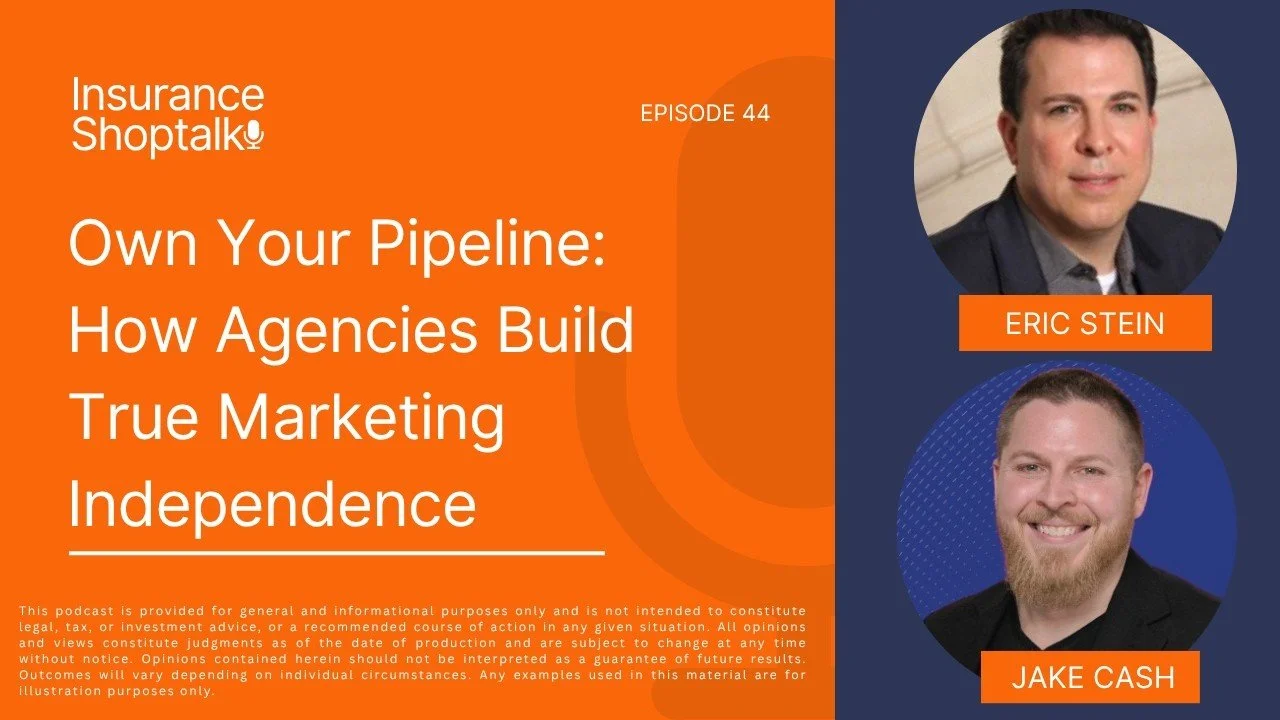
Most insurance agency owners don't realize how exposed they are until something outside their control forces a restart. In this episode, Jake Cash, founder of Senryx Group and former national marketing strategist at Geico where he oversaw half a billion dollars in ad spend across 300-plus agencies, joins Carl Willis on the Digital Insurance Agent podcast to break down the five marketing vulnerabilities that leave agencies one carrier decision, one lost producer, or one algorithm change away from starting over. If you own or run an insurance agency and want to understand where your growth is most at risk and what to do about it, this episode is required listening.
WHAT WE COVER
Why insurance agency marketing is 50% art and 50% science, and what that balance looks like in practice for agency owners
The ten-step marketing checklist Senryx developed to help agencies layer on channels in the correct order for maximum ROI
How backend automation and speed to lead directly impact conversion rates, including the stat that you are 380 times more likely to convert a lead contacted within the first 90 seconds
Why more leads will not fix your agency if the back-end systems are not built to convert and retain them
The messaging problem holding most commercial insurance agencies back from differentiation and growth
How to build an ideal client profile and speak directly to their pain points, a core pillar of any effective insurance marketing strategy
Why client retention is the most overlooked lever in insurance agency growth, and how one J.D. Power study found only 55% of commercial clients said they would definitely renew
The five stages of marketing independence: vendor dependence, person dependence, channel dependence, platform dependence, and carrier dependence
How top-performing agencies split new business roughly one-third referrals, one-third digital marketing for insurance agencies, and one-third traditional marketing
Why a one-size-fits-all PNC agency marketing strategy rarely works, and how to build a system matched to your actual strengths and interests
Where AI fits into insurance agency operations right now, what it is good for, what to avoid, and how not to become over-reliant on any single model
The done-for-you to marketing independence model Senryx uses, with the goal of training agencies to run their own systems within 6 to 12 months
Resources from This Episode
Marketing Independence Assessment: Free 2-minute scorecard. Find out which of the five dependencies is your biggest vulnerability.
Book a Call: Strategy, execution, and training for insurance agencies who want to own their growth.
Jake Cash on LinkedIn: Connect with Jake directly. Practical content for insurance agency owners posted weekly.
-
"Our goal is that after 6 to 12 months of working together, we can train you or your team to not need us anymore." — Jake Cash
"Seeing the scale that comes with managing a half-billion dollars in ad spend really gave me a clear view into what separates agencies that thrive from those that don't." — Jake Cash
"Marketing is 50% art and 50% science. You're never going to get to 100% science, and you're never going to get to 100% art." — Jake Cash
"A lot of the issues we've seen on the commercial side come down to messaging and not really differentiating yourself amongst other agencies." — Jake Cash
"It's not usually a conversation of, hey, you're not trying hard to grow. It's usually that you're trying so hard that you can't take a step back out of the weeds." — Jake Cash
"It's very easy to just say, if I had more people knocking on my door looking for my services, we'd be in a better spot." — Jake Cash
"I've seen what's worked for at least 300 agencies over the last ten years, and not every agency is the same. I don't believe in a one-size-fits-all from a marketing standpoint." — Jake Cash
"What makes growth repeatable is when the system is built to match the strengths and interests of the agency it goes with." — Jake Cash
"We all have to start out being over-reliant on certain things because we're resource-strapped." — Jake Cash
"That is a true definition of speed to lead. I'm in the middle of checking out, and they're calling me." — Eric Stein
"I had a chiropractor tell me, my goal is for you not to see me again." — Eric Stein
-
00:00:00 Marketing Independence Preview. Jake previews Senryx's core philosophy of training agencies to eventually run their own marketing systems without ongoing reliance on outside vendors.
00:00:29 Guest Introduction. Eric Stein introduces the episode and frames the conversation around AI, lead generation, and adapting marketing strategies in a fast-moving environment.
00:02:20 Jake's Background and Geico Experience. Jake walks through ten years working with 300-plus agencies, managing national marketing strategy at Geico with half a billion dollars in ad spend.
00:03:03 The California Incident That Started Senryx. Jake describes watching 35 agency owners lose their Geico appointments in California in 2021 and how that motivated him to build a marketing independence framework.
00:05:03 The Formulaic Approach to Marketing. Jake explains the 50/50 art and science model behind the Senryx ten-step marketing checklist and where most agencies go wrong before running ads.
00:07:42 Backend Automation and Speed to Lead. Jake and Eric dig into why CRM integration, lead tracking, and automated outreach are prerequisites for any paid advertising to work effectively.
00:11:53 Commercial Lines Messaging Problems. Jake identifies weak client profiling and generic messaging as the top marketing mistake on the commercial side.
00:13:23 Speaking the Client's Language. The conversation shifts to how dialing in a specific ideal client profile and addressing real day-to-day problems drives trust and conversion.
00:15:58 What Agency Owners Are Actually Good At. Jake explains why most owners come from a sales background, which is both their greatest strength and the reason they struggle to step back and build diversified marketing systems.
00:17:33 The Leaky Bucket Problem. Jake unpacks why more leads without strong conversion systems and retention processes just means restarting from zero every year.
00:19:49 Building a Custom Marketing System. Jake walks through the diagnostic, strategy, and done-for-you build process Senryx uses for agencies looking to grow in a sustainable way.
00:25:08 The Five Stages of Marketing Independence. Jake outlines the full framework: vendor, person, channel, platform, and carrier dependence, and how agencies can reduce vulnerability in each area over time.
00:29:21 AI in Insurance Agency Marketing. Jake and Eric discuss how to integrate AI responsibly, where it adds real operational value, and why you should not get locked into a single model.
00:37:15 Free Senryx Resources. Jake walks through the retention assessment, positioning assessment, and marketing independence scorecard available at senryx.com.
00:39:16 How to Connect with Jake. Jake shares how to reach him via LinkedIn and schedule a free strategy session through the Senryx website.
-
Jake Cash [00:00:00] Our goal is that after 6 to 12 months of working together, we can actually train you or your team to not need us anymore, because I think there's a lot of dependencies out there in the marketing space where there's agencies that are trying to make you reliant on them so that they can keep you as customers for a long time. And we're trying to flip the script on that a little bit to allow you to have higher ROI in the future by being able to manage some of the small things yourself to keep the system running.
Eric Stein [00:00:29] Welcome to Insurance Shop Talk.
Eric Stein [00:00:37] This is the podcast where the world of commercial insurance gets a little closer to home. I'm your host, Eric Stein, and in every episode we're taking a deep dive into the insurance industry. From the latest news and trends to in-depth interviews with insurance experts, carriers, and agency newsmakers. We're covering it all. So sit back, tune in, and let's start the conversation.
Eric Stein [00:01:03] All right. Today we've got Jake Cash with us.
Eric Stein [00:01:05] I love the name Jake. It reminds me of Johnny Cash. Jake, thanks for coming in.
Jake Cash [00:01:09] Yeah, thanks for having me, Eric.
Eric Stein [00:01:11] Appreciate it. Jake is a marketing expert for insurance agencies, both commercial and personal lines. And I know that we're all trying to adjust our strategies for working in the new environment of AI and just how fast things are moving and changing, even in the last 6 or 8 months. And I thought it would be great to have Jake on to walk us through some of the updates of what's happening and how we can execute on some of this to get new business and just set up our agencies in a way that is successful, from lead gen to referrals to everything. So Jake, why don't you start by giving us a little bit about your elevator pitch, your background, what you've done in the past in the insurance world, and what you're doing now.
Jake Cash [00:02:04] Yeah, thanks for the background, Eric. I always think it's funny when I get the Johnny Cash jokes. I feel like I've probably heard a thousand of those in my life, but they never get old. I wish I was related.
Eric Stein [00:02:15] You know, like, you can sing a little bit, to be honest. Like a performer, like a country performer. But anyway.
Jake Cash [00:02:20] I wish. If I could, I wouldn't be here talking to you today. So over the last ten years or so, I've worked with over 300 insurance agencies helping them grow their book of business. A lot of that time was spent inside Geico, managing their national marketing strategy for their agency network and running campaigns with partners like Meta, Google, and Disney, and negotiating sponsorships with NBA and MLB teams. Seeing the scale that comes with managing a half-billion dollars in ad spend really gave me a clear view into what separates agencies that thrive from those that don't.
Jake Cash [00:03:03] So there was a specific time back in 2021 when I had just left Geico a few months prior, and there was a decision made by Geico to stop writing new business in the entire state of California. We all know in the insurance space that California has been pretty rough for quite a while. I don't blame them for that business decision. But the impact that I saw with over 35 agency owners that I had worked with for years, having to start from the ground up again because they lost their appointments, really gave me the charge to start Senryx Group, which is our marketing firm. Our goal was to help agencies develop marketing independence by running them through a roadmap and a system to allow them to not be too dependent on any one carrier, vendor, key person, channel, or platform so that their growth can be more sustainable and less vulnerable to those certain instances like what happened back in 2021 in California.
Jake Cash [00:04:09] So excited to get more into marketing and what's going on in the insurance space right now and to have a conversation today.
Eric Stein [00:04:18] Definitely. So it looks like you got the corporate insurance side, the big picture from a marketing standpoint that most of us as small business owners didn't have that kind of training or expertise. We all know the tactical side, cold calling, telemarketing, email marketing, social media marketing, from a tactical level. But we don't know that overall overarching process. When you do your audits with agencies for marketing, to assess what their needs are, what do you see most agents wasting money on right now?
Jake Cash [00:05:03] What that time at Geico really taught me, seeing that kind of capital deployed at scale, was that when you take a step back and see it from a 10,000-foot view, there really is a formulaic approach to marketing.
Jake Cash [00:05:16] And if you combine that formulaic approach, I like to say it's 50% art and 50% science. You're never going to get to 100% science, and you're never going to get to 100% art. But if you can find that perfect match and that good combination of boots on the ground combined with strategy, that's where you hit the sweet spot. So we actually developed, based on that formulaic approach we took at Geico, what we call a ten-step marketing checklist. It's available on our site, free to download, and it gives you an idea of how to layer on marketing channels in the correct way to get the highest ROI. One quick thing I see a lot of agencies jump into is running ads on platforms without having the backend automation set up to support those ads when leads are actually coming through the door.
Jake Cash [00:06:13] Figuring out how to set up the foundations of your marketing to allow every channel you add on to become more profitable is one thing we love to have conversations about in those assessments together.
Eric Stein [00:06:25] So let's give people the website so they know how to download that. It's senryx.com, correct?
Jake Cash [00:06:35] That's correct.
Eric Stein [00:06:36] And is there a specific tab they go to?
Jake Cash [00:06:39] Yeah. On the insights tab we have three different free assessments, a bunch of different downloadable resources, and some blogs in case people are thirsty for education or maybe just looking for something to read at night.
Eric Stein [00:06:54] I gotcha. So senryx.com for the Senryx Group. Go to the insights tab at the top right corner and you can download a few of the guides, their marketing checklist, and so on.
Eric Stein [00:07:12] And a free AI prompt package too. Some cool stuff there. So that's good. As far as what you were saying about having the backend pieces together, I guess if you're going to run a Facebook ad, if someone contacts you from that ad, you've got a way to track it, it's not just an email request, their forms are going into a CRM. Is that kind of what you mean by having that dialed in to a process?
Jake Cash [00:07:42] Exactly. And not just the backend tracking, but also the outreach going out to the prospect. Speed to lead is a huge thing when you're doing any type of advertising that's driving leads. If that person is interacting with your ad, they're likely interacting with a competitor at some point as well. The data suggests that the fastest person to reach out is going to win. There's a stat out there that says you're 380 times more likely to convert if you contact a lead within the first 90 seconds.
Jake Cash [00:08:15] So if you have those automations in place to make that speed to lead happen, it's just going to be a lot more fruitful for you when you run those types of campaigns.
Eric Stein [00:08:23] Yeah. I got a little experience from the other side of that, with a somewhat different analogy, but from a Facebook ad. I was getting updated on my insurance and I was doing it online. I even had the appointment, I think, with the carrier, but I just didn't feel like messing with it. It was a Sunday. So I went online, filled out the data. They had a really strong website in terms of being extremely simple, good clean user experience to get the quote, and the policy was delivered by email like two seconds later. And I was deciding whether to add cyber coverage to it, and I had some questions about how much I might need based on what we do.
Eric Stein [00:09:12] And lo and behold, an agent calls me from the carrier, because they do direct and they go through agencies. And I was able to ask my question because, at that speed to lead, that was literally right as I was about to check out and put the credit card in. She called, and I normally send those to voicemail, but I saw the carrier name on the caller ID and figured I had a question anyway. So while she was on the phone, I got my answer, went ahead and bound it, made sure I got everything. The policy was emailed to me, and I was able to update one of my licenses in one of the states because I needed that.
Eric Stein [00:10:06] To your point, man, that is a true definition of speed to lead. I'm in the middle of checking out, and they're calling me. They know I'm on the website.
Jake Cash [00:10:16] Props to them. They clearly have their systems down. It's funny you say that too, because I think it was J.D. Power in a study they conducted last year that said 74% of consumers research online for their insurance needs, but only 25% actually purchase online. So it seems like exactly what you're describing, where we all like to start the process online, but a lot of times we end up having questions and need a little more hand-holding to actually finish the process. And so agencies and carriers, whatever type of insurance company you are, if you can have those processes in place to allow for that ideal buying cycle for the consumer, I think you're going to win in today's landscape.
Eric Stein [00:11:00] Hey everybody, it's Eric. I just want to pop in for a quick announcement. I just launched my new book on Amazon. It's called The Blueprint: An Insurance Agency's Unconventional Rise to the Top. It covers how I built Insurance Solutions since 2009, including the tech stack, the offshore and nearshore talent, and digital marketing techniques I used. So pick up a copy today on Amazon.
Eric Stein [00:11:53] Yeah, so that gave me the idea. If someone's on your site, you need to know they're even on it, and that they're starting to fill out a form mid-form. If you could call them at that moment, that's perfect, a little creepy possibly, but I think there's a fine line of too much knowledge about them. But yeah, that's a great system they've got in place. So when you're doing your assessments with agencies, let's talk about commercial lines for a minute. I know you have a heavy background on the personal side. What are you seeing agents do correctly, and what are the top things you see them doing incorrectly from a marketing standpoint?
Jake Cash [00:12:19] I think specifically on the commercial side, a lot of the issues come down to messaging and not really differentiating yourself among other commercial agencies. Take myself as an example. We are a marketing agency that works in the insurance industry, but it's not even enough anymore to just niche down to a specific industry. You have to have something that differentiates you beyond that niche as well. There are all these different agencies out there talking about how they have so many years of experience and great reviews. And yes, those things are table stakes, you need them to build trust with consumers. But what else makes you different from the other agency they're potentially looking to purchase from as well?
Jake Cash [00:12:53] That's one thing we work through in those processes, really just dialing in on who your ideal client is and what actually matters to that client, so that you can show that you can actually deliver on that in your messaging.
Eric Stein [00:13:23] So on that profile piece, you've got that profile and you now need to speak directly to them about their problem. It can't just be we've got the lowest price and best service, that whole generic piece. So if you're after, let's say, a transportation niche, what problems are they facing with fuel costs, commercial lines coverage increases, the hard market? Those are their problems. So is that what you mean by getting that message dialed in to that particular best client profile and industry?
Jake Cash [00:14:06] Exactly. If you can speak the same language they're speaking in their day to day, it shows that you understand them. And they're more likely to trust you and do business with you. I think this is becoming more and more important in today's environment as the market shifts as well. Organic growth is slowing down over the last few years on the commercial side. There was a study by J.D. Power that said only 55% of commercial customers say they are definitely going to renew this year, which was down six points year over year. That's a big drop. And the number one factor cited in that study was just communication and not being happy with service. So sometimes it's not only refining your messaging on the prospect side, but also refining your messaging to your current client base so that you're not just having to restart every year because you're draining clients on the back end.
Eric Stein [00:15:03] Yeah. So the service side. That could mean many things like your personnel, your processes, your tech stack. I know that's not really marketing, but it's the end result of the marketing, right?
Jake Cash [00:15:20] Absolutely. And there's a stat out there that it's 7 to 9 times cheaper to keep a client than it is to find a new one. So I think there's a lot that could be said for investing more in the service side, because that will allow your book to continue to stay and grow long term so that you can add fuel to the fire as you continue to grow and increase new business generation as well.
Eric Stein [00:15:50] Yeah, it makes sense. And that's some of the messaging piece you commonly see done incorrectly on the agency side. How about some things you commonly see them do well?
Jake Cash [00:15:58] I think most agency owners I talk to tend to come from a sales background. Everyone's pretty good at the old-fashioned sales game, building referral partners, shaking hands, kissing babies, all those things. And so it's not usually a conversation of hey, you're not trying hard to grow. It's usually that you're trying so hard that you can't actually take a step back out of the weeds and survey where your time is going, where your money is going, and figure out whether all that hard work and grind-heavy culture is actually the best use of your time and resources. It ends up being a blessing and a curse, because they're so good at building relationships and winning business that way that it almost ends up hindering their growth at some point, because they don't know how to step back and diversify their marketing to actually grow.
Eric Stein [00:17:01] Got it. And they're willing to handle everything because they are probably the number one sales producer in the agency, in addition to operating it. So they get bogged down.
Jake Cash [00:17:13] Absolutely.
Eric Stein [00:17:15] That makes sense. One of the things you mentioned before is that more leads won't necessarily fix your agency. What do you mean by that, and how do you address that concept?
Jake Cash [00:17:33] It's very easy to just say, if I had more people knocking on my door looking for my services, we'd be in a better spot. But a lot of times you might run into what I call a leaky bucket scenario. If you're doing a really good job at lead generation, maybe you have so many leads coming through that you don't care as much about the automations to make sure they're converting at the correct rate. Or maybe you're bringing somebody in but wasting dollars on the new business front because you're not converting them at a high enough rate for your return on ad spend to be where it needs to be. So thinking about the backend processes to actually convert those leads and making sure they're at a good spot is important.
Jake Cash [00:17:56] And then the second leaky bucket is that retention piece. Because you could get as many leads as you want and write as much new business as you can, but if you can't retain those policies, it's just restarting every calendar year.
Eric Stein [00:18:29] Right. Because usually incumbent agents are going to have a high percentage of retaining that business. But I hear what you're saying. It seems to be dropping a little bit from what you're seeing in the stats. So looking at that service and process angle is important as well. In terms of the systems you try to deploy for clients from a marketing standpoint, can you walk me through the ideal scenario for, let's say, a commercial agency that also has personal lines, they're growing but want to do more, they've got some good systems in place, they understand delegation and marketing tech from a big-picture standpoint, and they're a smaller agency, say with 5 to 10 producers. How do you jump in and really help that agency when they've got a good baseline but are looking to grow in a quality way?
Jake Cash [00:19:49] I think now that AI is so prominent, it's really easy to spin up content. And there are a lot of what I like to call marketing bros out there selling you on their services as the only way to grow your insurance agency. I've seen what's worked for at least 300 agencies over the last ten years, and not every agency got there the same way. I think there are a thousand ways to make it work. What we like to do is start with a diagnostic conversation where we take a look at what you're doing currently, where your book is at, where you want to go, who your ideal client is, and what resources you have available to solve this problem. Then we take all of those pieces and develop a strategy that's custom fit for you.
Jake Cash [00:20:02] I don't believe in a one-size-fits-all approach from a marketing standpoint. So we try to develop something that's going to work based on your strengths, your weaknesses, your resources, and your client base. From there, we develop the system for you. If you already have parts of it in place, the idea is to optimize it. If we're building something new, that's something we would do as a done-for-you service, with the goal of after 6 to 12 months of working together, being able to train you or your team to not need us anymore. Because there are a lot of dependencies in the marketing space where agencies try to make you reliant on them so they can keep you as customers long term. We're trying to flip the script on that to allow you to have higher ROI in the future by managing some of the small things yourself to keep the system running.
Eric Stein [00:21:33] No, that's great. I actually had a chiropractor tell me his goal was for me not to see him again. So he gets you to the position where you've got the homework you're supposed to do at home on your injuries so you don't need to keep coming back. That's refreshing to hear your approach on that, because the idea that you have to keep someone on retainer means more expense to an agency. But that sounds like a good foundational model. As far as repeatable, measurable marketing systems, can you go into a little bit more on how you implement those?
Jake Cash [00:22:23] Yeah. I personally am not a huge social media person. I use it because I have to for my job. But I know some people live and die on Facebook and love being in the comments, or on LinkedIn if that's where their client base is. And so part of what we do when we develop that system for you is talk about what you like and what you don't like to do. Because we're not going to tell you to live in the comments on organic social media to drive new business.
Jake Cash [00:22:50] If one, you don't have the time, or two, you just don't want to, because that's not a system that's going to fit you. What we think makes growth repeatable is when the system is built to match the strengths and interests of the agency it goes with, and not just saying we know Google Ads works so we're going to recommend it. What if you don't care to run that platform long term? That's part of the conversation, building systems that are repeatable and sustainable because they actually fit your strengths and interests.
Eric Stein [00:23:25] Gotcha. And so you help the agency continue to hone in on what they like doing from a marketing standpoint and what they will do continuously, and then update those models to see how they're performing and update the messaging and the process.
Jake Cash [00:23:51] Absolutely. Our goal is to hand off the system at some point. But honestly, we do have clients who've gotten to the point where they're like, this is going so well, we don't want you to hand it off. We just want you to keep running it because we don't have the time. So it's really about optionality. We want you to know that you don't have to be locked into a retainer. But some people decide to put their time and energy elsewhere, the system is working well, and we can move into a lower-level support engagement where you've got our help when you need it to dial back in and make tweaks and continue to optimize.
Eric Stein [00:24:32] So you have a team that can actually run the campaign or whatever the recommendation is for that agency if they want it.
Jake Cash [00:24:40] Absolutely.
Eric Stein [00:24:42] Got it. How long do you think it realistically takes for an agency to become marketing independent? I know everybody differs, but let's say it's that smaller agency with 5 to 10 producers, not a lot of resources or infrastructure for this long term. If they really wanted to focus and hone in, what's the fastest you've seen?
Jake Cash [00:25:08] We kind of look at it as a step ladder you're growing into over the course of honestly years sometimes. We think about marketing independence in five different buckets, and we've talked about a few of those, but let me lay them all out. The first would be vendor dependence. This is where you're too reliant on a vendor, where maybe they own the website that was built for you or the Google Ads account that was created for you, and you don't realize it until it's too late. They're keeping you around by controlling certain aspects of the relationship.
Jake Cash [00:25:39] The second would be person dependence. This is if you have one key producer that brings in an overwhelming percentage of new business for your agency. If you lost that person, you'd be in really rough shape. A lot of times it's the founder, or maybe this person holds all the relationships with your referral partners. The goal would be to diversify over time. The third would be channel dependence. The top performing agencies we've studied typically have a diversified new business stream coming from roughly a third referrals, a third digital marketing, and a third traditional marketing. The goal would be to diversify your marketing channels over time so you're not overly reliant on, say, a postage increase if you're big into direct mail.
Jake Cash [00:26:46] The fourth would be platform dependence. This is if you're heavily reliant on a platform you don't own. For example, organic social media, where you rely on an algorithm to reach your audience but don't control that algorithm. And then the fifth, which I almost skipped, is carrier dependence. This is more on the captive side, but we see it on the independent side as well, where maybe you're writing a high percentage of your new business with one specific carrier, and all of a sudden that carrier tweaks their product and you're no longer competitive from a product standpoint. So those are the five stages of dependency we see as a kind of step ladder over time, getting less and less reliant on each of those five.
Eric Stein [00:27:46] Yeah, that's really insightful. Because you're so in the weeds you don't have time to think through that from a long-term standpoint. You're just happy to have that producer producing and not really thinking about what happens if they leave or if that niche dries up. You just keep making the donuts without time to think it through. So back to your point about training and planning, that all comes into play here as well. I'm moving into the AI piece now. I know it's really helped me with content, honing in on messaging, giving me ideas, making me think differently about the problems clients are having and how to speak to that. What are your thoughts on how to integrate AI these days, given how quickly it's changing? Because I'd guess only maybe two out of ten agencies are even using something like Claude Cowork right now. So what do you recommend there?
Jake Cash [00:29:21] Yeah, it's like a full-time job just trying to keep up with AI news, and we all have full-time jobs running our own businesses. So it's extremely hard to keep up with. Speaking of dependencies, one thing we're noticing in our own use of AI is not being overly reliant on one model. Claude seems right now to be the best of the major competitors. We're able to get the best output from it. But it was ChatGPT right before that, and every time there's a new rollout, it seems like they're skipping ahead of each other. The differentiation between those models long term might not be that big because they're essentially training themselves off of each other's models to some extent. So I don't think you want to get too locked in on any one model too early, because it's so early in the growth phase of AI in general.
Jake Cash [00:29:46] But you need to be keeping up with it and playing with it, especially for backend operations right now. The things that are time consuming but not overly brain-intensive, that's where the money is at right now. Automating those time-intensive but lower-level tasks for your agency.
Eric Stein [00:30:45] Got it. And from a marketing perspective, where do you turn to AI to help agencies right now?
Jake Cash [00:31:06] There are a couple of things to think about. One would be being careful about messaging AI externally to your customer base. There was a stat from NBC in March that showed only 26% of the US population has a positive sentiment about AI. So it's a losing battle if you make your entire external value proposition about AI. You should absolutely be using it internally. That's one thing. Second, I think it's really great for research. We talked about messaging earlier. It's really great for getting inside the head of your ideal client, learning what challenges they have, continuing to prompt and ask questions about what their day to day looks like, how you could potentially solve problems for them. And the third piece is helping with backend automations, whether it's helping you with speed to lead, getting quotes done faster, handling things like dec pages, which have been an issue on the independent side for a long time. Using your time for higher-leverage activities is really where AI is coming into play right now.
Eric Stein [00:32:43] Have you run into Fivers, which is a Berkshire Hathaway company supporting workers comp? For those listening, Insurance Solutions has a national MGA appointment set up to allow you to quote, bind, and service workers comp at your agency. The coverage is in all states, it's A-rated, startups are accepted, there's a 125,000 maximum premium, and some of the tough industries they write include construction, transportation including towing and parcel delivery, manufacturing, armed and unarmed security guards, motor mediation, and many more. Go to our website at InsuranceSolutions.net, click the Get Appointed link, and we'll get your logins set up. We can also set up a webinar for training if you'd like. Feel free to email info at InsuranceSolutions.net or call 770-402-5343.
Eric Stein [00:33:51] You know, that makes sense. I forced myself, when Claude Cowork came out, to start paying for the account, get in there, poke around, watch a few YouTube videos to get the big picture, do some simple things. Like I set it up to answer my emails, and it reads them, drafts replies, and puts them in the drafts folder. I can't figure out how to do it for Microsoft yet, but it works for Gmail. And the way it responds, I had to edit each one usually, but at least 95% of it was there, and it was saying things in my own voice. So I've got two tools I've been using now, and there were a couple of times I was doing a task in Claude while simultaneously using another AI tool on my other screen.
Eric Stein [00:35:05] And I know with Cowork you can even have multiple agents doing things at the same time. I've got to figure that part out. But you've got to start playing with it. And even my college-age daughter, she thought it was just something you use like a Google search. I had to let her know this is where it's going in terms of execution now with AI. And for marketing I had to do some design work on brochures and it's really helpful, like you said, on the detail work. But you've got to have that big-picture plan to know where you're going long term. Is that fair?
Jake Cash [00:35:51] Absolutely. And I think if you put junk into it, you get junk out. Prompting is definitely a key. We've also been noticing that the more you can train it on your own data, the better. So if you have content you've already written over the years, feeding that content into it so it can start writing in your voice, for example. If you're using it to draft email replies, having it look at your email history so it can start drafting in your voice. Small things like that really add up over time as they continue to compound.
Eric Stein [00:36:33] Yeah, I can definitely see I have to rearrange quite a lot of my emails just because it's almost too professional sounding, like I'm an attorney or something. I can see the recipient thinking that was answered by an AI and he didn't really care about me. Thank God I catch that most of the time before I send it. Anything else you can think of that could be helpful to agencies looking to improve their marketing?
Jake Cash [00:37:15] For sure. We mentioned some of those resources earlier. We talked about retention. Some of the resources we have are free to use and take about 2 to 5 minutes to complete. We have a retention assessment that basically allows you to figure out how much you might be bleeding on the back end if your retention is not where it should be, or on the flip side, if you're killing it, it'll point that out as well. We also have a positioning assessment that will ask you questions to help you start thinking about the day-to-day struggles of your ideal client, and how to write content and messaging that hits home for them.
Jake Cash [00:37:55] And then we also have the marketing independence assessment up there as well. That allows you to get a scorecard of where you're at on that ladder of building your independence so that you're not too reliant on any one carrier, channel, or partner.
Eric Stein [00:38:11] Gotcha. I would say most agencies are relying heavily on their AMS. There are some newer AMS programs coming out that are more AI-oriented. It's going to be interesting to see how people migrate who have been with AMS360 forever, unless AMS360 can update quickly. But I like how you're focusing on dependence on tools and people, and watching that, because it can definitely hurt you.
Jake Cash [00:38:47] Yeah. It's not always a bad thing, as long as you recognize it and you're taking steps to reduce it over time.
Jake Cash [00:38:54] We all have to start out when we're growing our companies being over-reliant on certain things because we're resource-strapped. But as you start to grow and get more resources, it's about developing them in the right way to make your agency less vulnerable and make sure that, just like an investment portfolio, you're diversifying so that you don't have to restart from ground zero.
Eric Stein [00:39:16] No, it totally makes sense. Well, if anyone wants to get in touch with you, what is the best way to reach you if they have questions?
Jake Cash [00:39:26] If you want to head over to our website, senryx.com, we have some resources on there. You can also look me up on LinkedIn. My name is Jake Cash, spelled just like the money as you mentioned earlier, Eric. And you can also find a link on that website if you want to reach out and do a free strategy session. I'm happy to talk shop and develop relationships and hopefully add some value to the industry that's given me so much over the last ten years.
Eric Stein [00:40:01] No, it's fair. I appreciate it. Well, thanks for your time. And glad to have you on and glad to see that we're getting high-level talent from the corporate marketing side coming to help the small agencies we own, because that's desperately needed. Thanks for what you're doing for the whole industry.
Jake Cash [00:40:23] Really appreciate that, Eric. Thanks for having me on.
Eric Stein [00:40:26] Thanks, brother.
Eric Stein [00:40:29] Thanks again for tuning in to Insurance Shop Talk. If you enjoyed our deep dive into the latest trends, please don't forget to like, subscribe, and hit the notification bell so you never miss an episode. Until next time, I'm Eric Stein and this has been Insurance Shop Talk.