
Podcast Appearance
Why Your Agency Is More Vulnerable Than You Think
Jake Cash on Digital Insurance Agent with Carl Willis
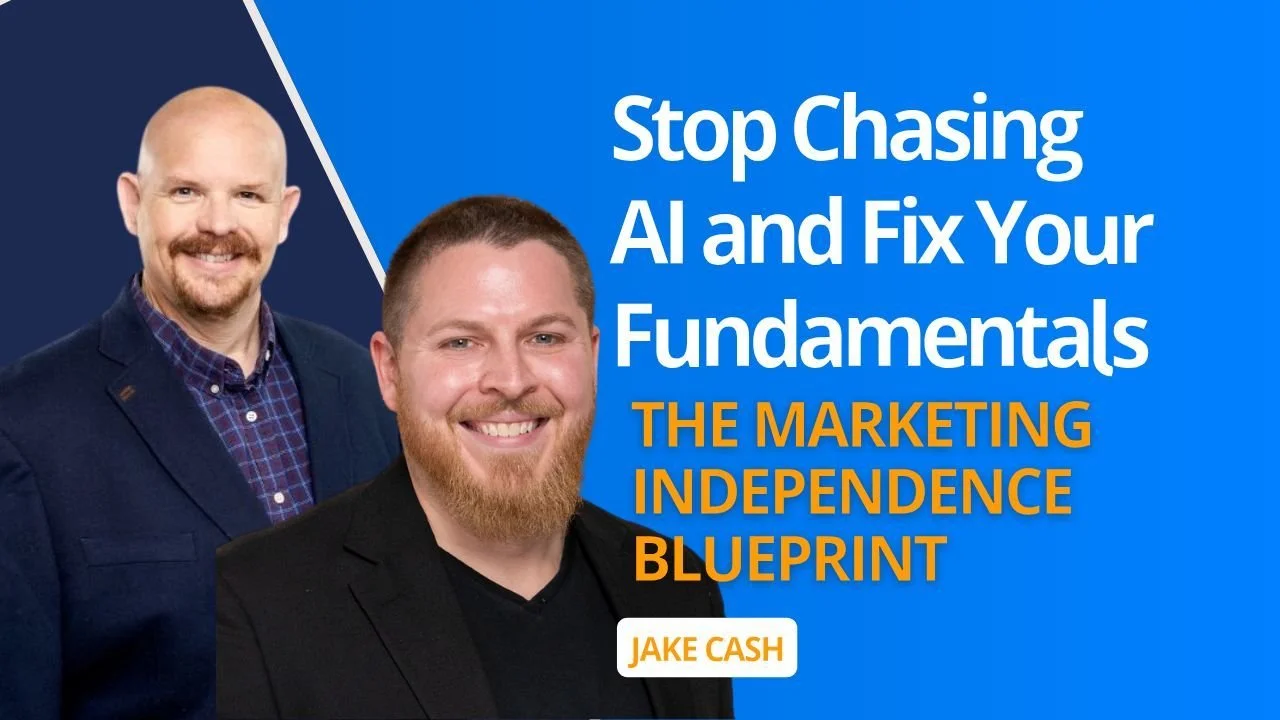
Jake Cash joined Carl Willis on the Digital Insurance Agent podcast to talk about marketing independence. The conversation covers carrier dependence, the five buckets of marketing vulnerability, AI overwhelm, differentiation, and why the fundamentals matter more than the latest tactic. If you own or run an insurance agency, this episode will help you see where you are most exposed and what to do about it.
What We Cover
Why carrier dependence leaves agencies exposed and what the Geico California exit revealed
The five buckets of marketing dependence: carrier, channel, vendor, platform, and people
How to think about AI without losing track of your business
The NBC study: only 26% of consumers have a positive association with AI
Why the leaky bucket problem appears every time lead generation gets fixed
The fundamentals most agencies skip before chasing the next tactic
Trust signals in the deepfake era: why Google reviews matter more than ever
How to find real differentiation when the product is the same for everyone
Why specialization opens referral networks instead of closing them
What the top 10% of 300+ agencies had in common: a diversified mix of new business
The Senryx model: 6 to 12 months, build the strategy, train the team, hand it off
Resources from This Episode
Marketing Independence Assessment: Free 2-minute scorecard. Find out which of the five dependencies is your biggest vulnerability.
Book a Call: Strategy, execution, and training for insurance agencies who want to own their growth.
Jake Cash on LinkedIn: Connect with Jake directly. Practical content for insurance agency owners posted weekly.
-
Carl Willis [00:00:55]Welcome to the Digital Insurance Agent podcast. With me is Jake Cash. Jake, so glad to have you. We are going to have fun today because we are actually competitors. We are going to talk about the industry, talk about marketing, and really dig into what you as an insurance agent or agency owner should be thinking about today.
Jake Cash [00:01:32]I appreciate you having me, Carl. Over the last ten years, I have helped over 300 insurance agencies grow their book of business, and a lot of that time was spent inside Geico managing national marketing strategy for their agency network. Managing ad spend of over half a billion dollars, partnerships with the NBA, MLB, Disney, Meta, Google. That scale gave me a really clear view into what separates agencies that thrive from those that do not.
Jake Cash [00:02:25]What charged me to start Senryx was this idea of marketing independence. Back in 2021, Geico made a business decision to stop writing new business in California. I had many friends at insurance agencies in that state. The impact it had on their lives and their families, having to figure out what their next step looked like, is what founded Senryx on this core belief: you should not have to be so reliant on a specific carrier or a specific vendor.
Jake Cash [00:04:53]It is a double-edged sword. Captive agents get so much support from the carrier they represent. It is impossible for an agency to build a brand the size of an Allstate or a State Farm or a Geico without billions of dollars over 75-plus years. Riding that wave of brand awareness is amazing. But sometimes these agencies get a little fat and happy, a little too reliant on that support, and they have not built up their own systems or generated their own business. When the carrier decides the market is no longer profitable and pulls back, they are left high and dry.
Jake Cash [00:05:43]The agencies that withstand those periods are the ones that really make it in the long run. When the faucet turns back on, they can ride that wave and they have their own systems built in the background that they are also capitalizing off of.
Jake Cash [00:08:02]We have broken this marketing independence philosophy into five different buckets of dependence. The first is carrier dependence. The second is channel dependence. Most agency owners come from a sales background and are great at referrals. But what happens if you are trying to scale your team and that major referral source goes away, or you lose a key producer? You have to rebuild from ground zero. The third is vendor dependence. Sometimes people realize they do not own their website or their automations, and when they want to shift, they find they are being held captive by a marketing vendor. The fourth is platform dependence. Heavy reliance on Google Ads, Meta Ads, or SEO. Those can perform well, but one algorithm change and your pipeline dries up.
Jake Cash [00:11:17]We like to call it diversification of your marketing. Having a portfolio of channels: traditional marketing, digital marketing, and referral marketing. So you are not too reliant on any one of them.
Jake Cash [00:12:28]There is a lot of noise. It seems like it is basically a full-time job just to keep up with the news in the industry. You have to separate the noise from what can actually help your insurance agency right now. The pitfall I see is people spending almost 24/7 thinking about AI. It is great to be an early adopter. But it can become a huge distraction if you are spending all your time thinking about AI and forgetting what got you there, losing track of your numbers, your team, your book.
Jake Cash [00:14:51]Whenever we solve the lead generation problem for clients, it often turns into a different problem. Like a leaky bucket on the back end where they are not handling leads the right way, or they have a retention issue. They have not figured out how to follow up with policyholders in a way that adds value and makes them sticky.
Jake Cash [00:17:22]There is so much hype around AI right now. There was actually a study by NBC in March. They asked consumers how they felt about AI, and only 26% had a positive association. 56% had used some sort of AI platform in the last month, but only 26% felt good about it. Be careful making AI the sole messaging of your agency. There is a lot AI can help with on the back end, from a process standpoint, to make yourself more efficient, to make your team more efficient. But you need your messaging dialed in about what differentiates you, so that when people look you up, they know what you stand for.
Jake Cash [00:19:57]A lot of agencies are chasing the shiny object, investing in cool AI systems or the latest tactics, when they do not have the fundamentals figured out. Is your website messaging built to signal trust to a consumer who lands on it? Is it built to convert? It is like a car with bad brakes. You take it to the shop and ask for a new engine because you want to go fast, but fix the brakes first. Make sure you can get from A to B before you upgrade the engine.
Jake Cash [00:22:06]In the age of AI, where it is so much easier to spin up content, people are not believing what they see online. Having verifiable trust signals is going to take that doubt away from a customer's mind. Things like Google reviews not only show the consumer you are trusted before they reach out, they show Google too, making it more likely to recommend you.
Jake Cash [00:22:42]There is a stat by Nielsen that 92% of consumers trust word of mouth more than any type of advertising. Reviews are the closest thing on the digital side to word of mouth. Having those trust signals, for people and for search engines, is essential. And niching down your messaging means it speaks directly to the right individual and condenses your competitive set.
Jake Cash [00:25:03]In insurance, you do not differentiate from a product standpoint. You are selling a product people hope they never use. So a lot of our conversations with agencies come down to: what do your best customers have in common? What appeals to them? And looking internally at your strengths, weaknesses, and background. If you were a teacher before you became an insurance agent, approach your marketing with the heart of a teacher. If your family was in music, approach the insurance game like a jazz set and build your referral network inside the music industry.
Jake Cash [00:27:54]It is going to be easier for AI to do a lot of what generalists do. The more you can build a moat around your specialization, the better as we move forward.
Jake Cash [00:29:38]When you are in networks of other insurance agencies with different niches, it opens up an entirely different stream of new business through referrals with your peers. I know an agricultural insurance agent with strong relationships with generalist agents you would assume were competitors. Because they serve different markets, they actually send business back and forth.
Jake Cash [00:30:52]The top 10% of performers from the insurance agencies we studied had one thing in common: a diversified mix of new business generation. Roughly a third from referral sources. A third from traditional marketing. A third from digital. Having a presence in all of those buckets is also sending trust and authority signals back to Google, other search engines, and LLMs, making them more likely to recommend you.
Jake Cash [00:33:28]We provide the opportunity for agencies who want more control to come on for 6 to 12 months, build a strategy with us from the ground up, and then learn how to take that strategy and run with it, so they no longer have to be dependent on a partner like us to sustain their business.
Jake Cash [00:36:28]I am channel agnostic. I believe in developing a strategy alongside you that fits your audience, your strengths, and your interests. If you are not going to show up and engage on LinkedIn, then that should not be your strategy. Find someone willing to meet you where you are at, not fit you into their specific system.
Jake Cash [00:38:31]Do not forget your ground game. Do not get too sucked into the hype of AI, but do not completely ignore it either because it is important. And remember that the quickest way to something, a growth hack, might not always be the most sustainable way. It might actually create more problems in the future than it fixed in the present.
-
00:00:00 Introduction. Jake Cash and Carl Willis. Two competitors sitting down to talk shop.
00:01:32 Jake's background. 10 years. 300+ agencies. Half a billion dollars in ad spend at Geico. Partnerships with the NBA, MLB, Disney, Meta, and Google.
00:02:25 The founding moment. Geico exits California. Agency owners Jake knew personally had to figure out their next step. That is what founded Senryx.
00:04:53 The double-edged sword of carrier support. The brand wave is real. The dependency is dangerous. What happens when the carrier decides your market is no longer profitable.
00:05:43 The agencies that survive. They built their own systems before they needed them. When the faucet turns back on, they can ride both streams at once.
00:08:02 The five buckets of marketing dependence. Carrier. Channel. Vendor. Platform. People. How to look honestly at how vulnerable your new business generation really is.
00:09:06 Vendor dependence. You might not own your website or your automations. When you want to leave, you find out you cannot.
00:11:17 Diversification as a portfolio. Traditional marketing, digital marketing, and referral marketing. A mix that holds when one source slows down.
00:12:28 AI overwhelm. Agents calling to ask which model to use. The problem with making AI a full-time job.
00:13:14 The distraction trap. Being an early adopter is smart. Forgetting what got you here is not. Losing track of your numbers, your team, your book.
00:14:51 The leaky bucket. Solve lead generation. Discover the conversion problem. Fix that. Now retention is slipping. One problem solved reveals the next one.
00:17:22 The NBC study. 56% of consumers used AI in the last month. Only 26% have a positive association with it. What that means for how you message your agency.
00:19:57 Chasing the shiny object. Cool AI systems and the latest tactics before the fundamentals are in place. The car with bad brakes asking for a new engine.
00:22:06 Trust signals in the age of deepfakes. People are not believing what they see online. Verifiable signals like reviews take the doubt away before a prospect ever reaches out.
00:22:42 Google reviews as digital word of mouth. Nielsen: 92% of consumers trust word of mouth over any form of advertising. Reviews are the closest thing to that on the internet.
00:25:03 Differentiation in insurance. You cannot differentiate from the product. It starts with your best customers, what they have in common, and then looks inward at your strengths and background.
00:27:54 AI and the generalist problem. AI is going to be very good at what generalists do. The more you can build a moat around your specialization, the better positioned you are.
00:28:34 How to specialize without shrinking. Match your niche to a market large enough to make a living. The agricultural agent who sends business back and forth with generalists.
00:30:52 What the top 10% have in common. Data from 300+ agencies. One pattern at the top every time: a diversified mix. Roughly a third referral, a third traditional, a third digital.
00:32:55 The Senryx model. 6 to 12 months. Build the strategy alongside the agency. Train them to run it. No dependency on a partner to sustain the business.
00:36:28 Channel agnostic. No one-size-fits-all. No silver bullet. A strategy that fits your audience, your strengths, and your interests.
00:38:31 Closing advice. Do not forget the ground game. Do not ignore AI. The quickest path to growth is not always the most sustainable one.
-
Carl Willis [00:00:55]Welcome to the Digital Insurance Agent podcast. With me is Jake Cash. Jake, so glad to have you. We are going to have fun today because we are actually competitors. We are going to talk about the industry, talk about marketing, and really dig into what you as an insurance agent or agency owner should be thinking about today. Jake, welcome. Start off with your background.
Jake Cash [00:01:32]I appreciate you having me, Carl. Over the last ten years, I have helped over 300 insurance agencies grow their book of business, and a lot of that time was spent inside Geico managing national marketing strategy for their agency network. Managing ad spend of over half a billion dollars, partnerships with the NBA, MLB, Disney, Meta, Google. That scale gave me a really clear view into what separates agencies that thrive from those that do not. What I noticed the most, and what charged me to start Senryx, was this idea and core philosophy of marketing independence.
Jake Cash [00:02:25]Back in 2021, Geico made a business decision to stop writing new business in California. I had many friends at insurance agencies in that state. The impact it had on their lives and their families, having to figure out what their next step looked like, is what founded Senryx on this core belief: you should not have to be so reliant on a specific carrier or a specific vendor.
Carl Willis [00:03:25]A moment of silence for the California agents, because it has been tough. Last couple of years they have really had to learn how to strategize and play the game differently. And that is a lot of what we want to get into today. In the last ten or fifteen years it has been easy to be a little lazy. Technology helped you sit back and be an order taker. So Jake, let's set the table. We want to talk about growth, control, and real world execution. The real problem is this lack of control. Captive agents have this reliance on their carrier. What is the real danger with that?
Jake Cash [00:04:53]It is a double-edged sword. Captive agents get so much support from the carrier they represent, and that is genuinely valuable. It is impossible for an agency to build a brand the size of an Allstate or a State Farm or a Geico without billions of dollars over 75-plus years. Riding that wave of brand awareness is amazing. But sometimes these agencies get a little fat and happy, a little too reliant on that support, and they have not built up their own systems or generated their own business. When the carrier decides the market is no longer profitable and pulls back, they are left high and dry.
Jake Cash [00:05:43]The agencies that withstand those periods are the ones that really make it in the long run. When the faucet turns back on, they can ride that wave and they have their own systems built in the background that they are also capitalizing off of.
Carl Willis [00:06:29]That is so critical. The other piece is that the big brand really brands the company, not the agent. The carrier has no problem sticking another agent a mile down the road from you. At the end of the day, the local agent still has to answer the question: why you? If you have not put the systems in place, if you have not taken the time to play the ground game, you are going to lose. So what does owning your own growth versus depending on somebody else actually mean?
Jake Cash [00:08:02]We have broken this marketing independence philosophy into five different buckets of dependence. The first is carrier dependence, which we have mostly been talking about. The second is channel dependence. Most agency owners come from a sales background and are great at referrals. But what happens when you are trying to scale your team and that major referral source goes away, or you lose a key producer? You have to rebuild from ground zero. The third is vendor dependence. Sometimes people realize they do not own their website or their automations, and when they want to shift, they find they are being held captive by a marketing vendor. The fourth is platform dependence. Heavy reliance on Google Ads, Meta Ads, or SEO. Those can perform well, but one algorithm change and your pipeline dries up.
Carl Willis [00:09:59]You brought up something critical. I call it being the one-trick pony. You have been so reliant on that one source of business and something shifts. The algorithm changes. Google rolls out generative AI and search changes. Facebook ads stop working the way they used to. Any little shift can change the dynamic. And people are multiple modality. Your customer starts the day on their phone, moves to a laptop, has the radio on in the car. You have to have the ecosystem working.
Jake Cash [00:11:17]Exactly. We like to call it diversification of your marketing. Having a portfolio of channels: traditional marketing, digital marketing, and referral marketing. So you are not too reliant on any one of them.
Carl Willis [00:11:41]Let's dive into AI overwhelm. Agents are calling me asking: do I use Claude? GPT? Perplexity? Gemini? They know enough to be dangerous. How do you keep from getting overwhelmed in this whole AI environment?
Jake Cash [00:12:28]There is a lot of noise. It seems like it is basically a full-time job just to keep up with the news in the industry. You have to separate what can actually help your insurance agency right now from everything else. The pitfall I see is people spending almost 24/7 thinking about AI. It is great to be an early adopter. But it can become where you are getting too into it and forgetting about what got you there, losing track of your numbers, your team, your book.
Jake Cash [00:13:14]The internet changed how everybody did business 25 or 30 years ago. AI is going to be very similar. 25 years from now, we will look back and forget what business was like before AI. But change happens slowly and then all at once. Spend a little less time doom scrolling about the impacts of AI and a little more time running your business.
Carl Willis [00:14:04]Here is something important. AI is going to amplify. If your systems are broken, it is going to amplify that. If your systems are dialed in, it is going to amplify that. It is going to show you exactly where you are broken or exactly where you are strong.
Jake Cash [00:14:51]Absolutely. We always find it interesting when we are working with a new client and they are really focused on generating new business. But a lot of times, whenever we solve that problem for them, it turns into a different problem. Like a leaky bucket on the back end where they are not handling the leads the right way to make the most out of them. Or they have the new business figured out but all of a sudden they have a retention issue and they have not figured out how to follow up with policyholders in the right way to add value and make them sticky.
Carl Willis [00:15:46]Let's talk about signal versus noise.
Jake Cash [00:17:22]There is so much hype around AI right now. There was actually a really interesting study done by NBC in March. They asked consumers how they felt about AI, and only 26% had a positive association. 56% had used some sort of AI platform in the last month, but only 26% felt good about it. Be careful making AI the sole messaging of your agency. There is a lot AI can help with on the back end to make you more efficient. But you need your messaging dialed in about what differentiates you, so that when people look you up, they know what you stand for and why they want to choose you.
Carl Willis [00:18:38]Everyone is chasing AI, but we both agreed everyone is also ignoring fundamentals. Strong teams win basketball games not because of sky high dunks but because of good dribbling, passing, and court management. What does a strong ground game look like for an insurance agency's marketing?
Jake Cash [00:19:57]A lot of agencies are chasing the shiny object, investing in cool AI systems or the latest tactics, when they do not have the fundamentals figured out. Is your website messaging built to signal trust to a consumer who lands on it? Is it built to convert? It is like a car with bad brakes. You take it to the shop and ask for a new engine because you want to go fast, but fix the brakes first. Make sure you can get from A to B before you upgrade the engine. If you are investing in all these cool automations but your messaging and fundamentals are not figured out, all that automation is not going to help anything.
Carl Willis [00:21:22]When it comes back to those fundamentals, the website has to be more than a brochure. It has to answer the question: why you. And it has to make the next step obvious. What are a couple of other levers that need to be quickly understood and available to that consumer?
Jake Cash [00:22:06]Trust signals are critical. In the age of AI, where it is so much easier to spin up content, people are not believing what they see online. Having verifiable trust signals is going to take that doubt away from a customer's mind and allow them to reach out. Things like Google reviews not only show the consumer you are trusted before they reach out, they show Google too, making it more likely to recommend you.
Jake Cash [00:22:42]There is a stat by Nielsen that 92% of consumers trust word of mouth more than any type of advertising. Reviews are the closest thing on the digital side to word of mouth. Having those trust signals, for people and for search engines, is essential. And niching down your messaging means it speaks directly to the right individual and condenses your competitive set.
Carl Willis [00:23:34]You hit on a goldmine there. Differentiation. I have put that question in front of groups of agents and they lock up. They list what they offer and the answer is always: so does everyone else. They have not thought through who their most valuable customer is, what they look like, where they go, what they care about. And they have not thought about why they specifically are valuable to that customer.
Jake Cash [00:25:03]In insurance, you do not differentiate from a product standpoint. You are selling a product people hope they never use. So a lot of our conversations with agencies come down to: what do your best customers have in common? What appeals to them? And looking internally at your strengths, weaknesses, and background. If you were a teacher before you became an insurance agent, approach your marketing with the heart of a teacher. If your family was in music, approach the insurance game like a jazz set and build your referral network inside the music industry. Thinking about your background, your strengths, your weaknesses, and combining that with the audience you serve is where your real differentiation lives.
Carl Willis [00:26:20]Niche down and become the go-to expert. In the medical field, the cardiologist makes a lot more than the family practitioner. Be the specialist. And honestly, AI is going to be very good at what generalists do. The more you can build a moat around your specialization, the better positioned you are as this plays out.
Jake Cash [00:27:54]Exactly. And I think it is going to be easier for AI to do a lot of what generalists do. The more you can build a moat around your specialization, the better as we move forward. You need to make sure you are specializing in something you understand and can be an expert in, but also in a market large enough to still make a good living.
Carl Willis [00:28:10]How do you advise a PNC agent, someone with car insurance, home insurance, life insurance, business insurance, how do you advise them to become a specialist in something?
Jake Cash [00:28:34]It depends on the market. If you are a local agent in Kansas, you might want a different specialization than somebody in New York City. Look at what people's occupations are in your area. What is your total addressable market? Make sure you are specializing in something you understand and that the market is large enough. I know an agricultural insurance agent with really strong relationships with generalist agents you would assume were competitors. Because they serve different markets, they actually send business back and forth. Specialization opens up an entirely different stream of new business through referrals with your peers.
Carl Willis [00:29:52]Google's AI is now answering the question: who should I choose? You do not get ten blue links anymore. Your positioning is now feeding that answer. How do you build a solid, well-rounded footprint today?
Jake Cash [00:30:52]We looked at growth data from about 300 insurance agencies, sliced it thousands of different ways looking for commonalities. The top 10% of performers had one thing in common: a diversified mix of new business generation. Roughly a third came from referral sources, whether that was friends and family, other insurance agencies, dealerships if you are focused on auto, mortgage brokers and real estate agents if you are focused on home. The second bucket was traditional marketing, brand awareness, local community presence. The third was digital: Google Ads, Meta Ads, SEO, local search. Having a presence in all of those buckets is also sending trust and authority signals back to Google, other search engines, and LLMs, making them more likely to recommend you.
Carl Willis [00:32:06]The word is authority. These AI models look for that authority signal across the full spectrum, online and offline. The more places you can demonstrate it, the better your chances. Let's talk about your model, ownership versus dependency.
Jake Cash [00:32:55]No model is one size fits all. What we offer is optionality for agencies who want more control. We bring an agency partner on for 6 to 12 months, build a strategy from the ground up alongside them, and then train them to run that strategy independently so they no longer have to depend on a partner like us to sustain their business. Think about how many subscriptions you manage in your personal life. That same subscription fatigue happens in business. Some agencies want to learn and take control. Others get to the end of that process and say you guys are doing great, let's keep going. Both are fine. It is about what is right for the agency.
Carl Willis [00:34:29]There are both types in the world. Some want help and then want to take the wheel. Others do not have the time or interest. And what we are finding is that the need evolves. Clients come to us for marketing but it turns into systems, operations, and scaling. Find a partner who can grow with you and is not siloed in their thinking.
Jake Cash [00:35:56]I completely agree. It is easy to find marketing people online promising that their one system is the only way to grow your insurance agency. I have personally seen agencies grow through direct mail, local SEO, Google Ads, Meta Ads, referrals: thousands of different paths. I am channel agnostic. I believe in developing a strategy alongside you that is going to fit your audience, your strengths, and your interests.
Jake Cash [00:36:28]If you are not going to show up and engage on LinkedIn, then that should not be your strategy. Find someone willing to meet you where you are at and build something sustainable, not a growth hack that solves one problem and creates three more.
Carl Willis [00:37:13]If you do not think down the road, you run into bottlenecks. Your marketing starts working but your systems break. Too many leads and then you have an operational failure. CRM issues, poor follow-up on leads, bad tracking, retention problems. Any others you can think of?
Jake Cash [00:37:52]I have also seen systems that were built as a DIY solution that worked to get the agency where it needed to get to, and then all of a sudden broke because there was too much capacity coming into it. Or it was developed by someone who left the agency. Band-aid approaches tend to create problems in the long run.
Carl Willis [00:38:20]Jake, as we wrap up, what are the key takeaways you would leave with our audience?
Jake Cash [00:38:31]Do not forget your ground game. Do not get too sucked into the hype of AI, but do not completely ignore it either because it is important. And remember that the quickest way to something, a growth hack, might not always be the most sustainable way. It might actually lead to more problems in the future than it fixed in the present. Think about how that marketing independence philosophy weaves through every decision you are making about how to grow your book.
Jake Cash [00:39:21]If you would like to find out more about anything we discussed today, you can head over to senryx.com/podcast. We have a free marketing independence assessment on there where you can find out your score in about two minutes. Most insurance agencies I have worked with have been surprised at how vulnerable they actually are. You can also book some time for a free marketing strategy chat with me on that site, and feel free to connect with me on LinkedIn. My name is Jake Cash, that is C-A-S-H, just like the money.
Carl Willis [00:40:09]Fantastic. Jake, it was great having you on. Great discussion today, and our audience, thanks for tuning in to the Digital Insurance Agent. We look forward to having you on our next episode.