
Podcast Appearance
Insurance Agency Marketing Strategy: Building Marketing Independence and Owning Your Growth
Jake Cash on the Insurance Leaders Lab Podcast with Nina Shepard
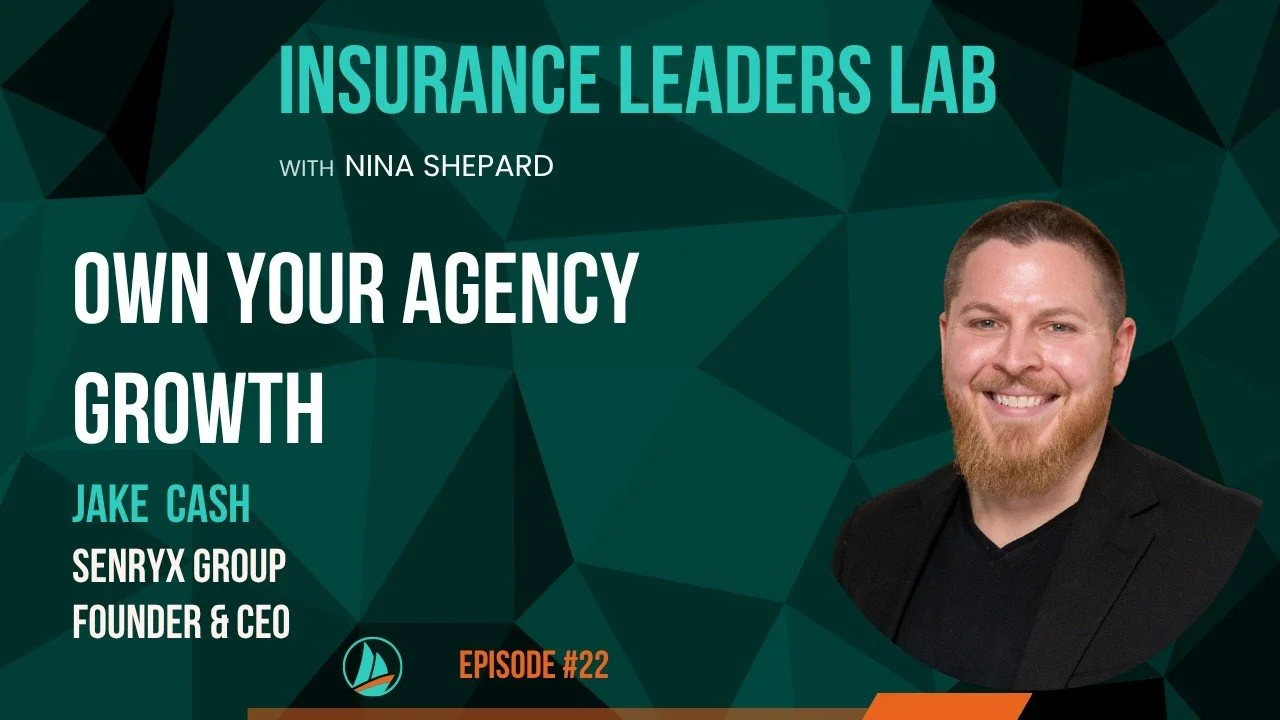
Jake Cash joined Nina Shepard on the Insurance Leaders Lab podcast to talk about marketing independence. The conversation covers vendor and carrier dependence, the three buckets top agencies use to diversify new business, AI overwhelm, human-advantage differentiation, and why the fundamentals matter more than the latest tactic. If you own or run an independent insurance agency, this episode will help you see where your growth is most exposed and what to do about it.
What We Cover
Why marketing independence matters: reducing your agency's dependency on key producers, vendors, carriers, platforms, and channels so you're resilient to external shocks.
The fundamentals that have to come first in any insurance agency marketing strategy: a website that clearly signals your value proposition, fast automated follow-up on inbound leads, and a consistent experience across every touchpoint.
Why the on-demand economy means independent agencies are held to the same standard as GEICO, Progressive, Amazon, and Netflix, and how to meet that expectation.
The biggest near-term opportunity in PNC agency marketing: leaning into your human advantage instead of competing on AI hype.
How to build a marketing strategy that is actually repeatable, designed around your real strengths, time, and budget rather than someone else's playbook.
What data from 300-plus agencies reveals about insurance agency growth: the top 10% diversify roughly evenly across referrals, digital marketing for insurance agencies, and traditional or word-of-mouth channels.
A real turnaround: how one Florida agency went from 50 policies a month to 400-plus in about six months.
Why you should stop renting and start owning your growth, and the one question to ask any automation or AI vendor before you sign.
Why optionality is the strategic priority for the next few years as AI tools leapfrog each other.
The "replace yourself" mindset and how training others to do your job removes the ceiling on your growth.
Resources from This Episode
Marketing Independence Assessment: Free 2-minute scorecard. Find out which of the five dependencies is your biggest vulnerability.
Book a Call: Strategy, execution, and training for insurance agencies who want to own their growth.
Jake Cash on LinkedIn: Connect with Jake directly. Practical content for insurance agency owners posted weekly.
-
"I like to say I didn't choose this industry, but it chose me." - Jake Cash
"If you don't have your fundamentals in place, a lot of times we see agencies fail because they don't have those fundamentals in the background that set them up for success when they try new tactics." - Jake Cash
"Consumers' expectations don't turn off when they go to talk to their insurance agent. They have the same expectations no matter who they're going through for their insurance." - Jake Cash
"The opportunity right now is to lean into your human advantage. Nobody likes to call a number and get stuck on an IVR for 15, 30, 45 minutes." - Jake Cash
"The best marketing strategy is a marketing strategy that's going to be actually repeatable." - Jake Cash
"Stop renting and start owning your growth. There are a lot of marketing agencies out there that just want you to keep paying them every month as opposed to essentially teaching you to fish." - Jake Cash
"If someone builds you an automation and you don't actually own that automation when they stop working with you, you'll have to restart from zero if you end that relationship." - Jake Cash
"Keeping some of that optionality in the mix, not fully building your entire agency off of one tech stack when it's changing so fast, is something I would definitely advise." - Jake Cash
"Replace yourself. If you're able to get to a place where you're not needed anymore because you've trained others to do exactly what you can do, that's where people really level up." - Jake Cash
"Lead by example, example, example." - Jake Cash
-
00:00:00 Introduction. Nina Shepard introduces Jake Cash and frames why most agencies let vendors control their growth.
00:01:56 How Jake got into insurance. Jake shares his path into the industry and his start in GEICO marketing.
00:03:13 The origin of marketing independence. How COVID-era dependence on a single income source inspired Senryx Group.
00:04:37 Lessons from GEICO. Why fundamentals have to be in place before any new marketing tactic can work.
00:06:31 Strategy beyond marketing. How Senryx starts every engagement with a 10,000-foot assessment and roadmap.
00:07:33 The on-demand economy challenge. Why consumer expectations from Amazon and Netflix carry over to insurance.
00:09:04 Leaning into the human advantage. Differentiating with real human service while everyone else touts AI.
00:10:42 Tailoring strategy to your strengths. Why hive-mind, one-size-fits-all marketing fails agencies.
00:11:41 Building a repeatable strategy. Designing marketing around what you can actually sustain.
00:13:48 The three-bucket diversification model. What 300-plus agencies reveal about how top performers split new business.
00:15:22 A Florida turnaround story. From near shutdown to 400-plus policies a month in six months.
00:16:38 Stop renting, start owning. Why bringing growth in-house beats permanent retainers.
00:17:51 What owning it really means. The vendor and automation ownership question to ask before you sign.
00:19:24 Optionality as a differentiator. Why not to build your agency on a single tech stack.
00:22:05 The $500 million experiment. Forcing diversification by giving up your best channel for a year.
00:24:49 Replace yourself. How training others removes the ceiling on your growth.
00:26:18 Resources and where to find Jake. Senryx tools and how to connect.
00:27:40 Final word: lead by example. Jake's closing leadership advice.
-
Nina Shepard [00:01:13] Good morning everyone. I'm excited to welcome Jake Cash to the Insurance Leaders Lab podcast. Most insurance agencies don't control their growth: their vendors do. Jake is on a mission to change that. As the founder of Senryx Group and former strategy lead at GEICO's agency network, where he managed $500 million-plus in media partnerships, Jake has helped more than 300 P&C agencies build systems they actually own. Good morning Jake.
Jake Cash [00:01:54] Good morning Nina. Thanks for having me.
Nina Shepard [00:01:56] I'm excited to talk about building a marketing strategy that supports independent agency growth. Before we go deeper, how did it all start for you?
Jake Cash [00:02:17] I found my way into the industry about a decade ago. I like to say I didn't choose it, but it chose me. I joined GEICO in marketing, and for someone from the marketing world, it felt like a really cool place to land: a brand built on witty comedy and advertising. The wow moment that kept me was actually meeting my wife in the GEICO marketing department. I have a lot to thank this industry for: my livelihood, my business, and my family.
Nina Shepard [00:03:13] Amazing. From there, how did you get to the idea of serving the independent agency segment?
Jake Cash [00:03:39] About five years ago during COVID, both my wife and I were drawing income from one company, which felt like the wrong strategy. That feeling of being overly dependent on one source led me to build Senryx Group around this core philosophy of marketing independence: helping insurance agencies build less dependency on key producers, vendors, carriers, platforms, and channels so they're less vulnerable to external factors that could impact their growth long term.
Nina Shepard [00:04:37] What are the main lessons you took from your GEICO experience into your new company?
Jake Cash [00:05:06] Managing that kind of capital at scale and testing marketing channels across the entire country taught me there's almost a formulaic approach to layering marketing channels for the highest ROI. It's really hard to separate signal from noise online. We're living in echo chambers built around our interests. It's easy to get caught up in the latest flashy tactic the marketing bros are touting. But if you don't have your fundamentals in place, a website that clearly signals your value proposition and fast automated follow-up for inbound leads, a lot of agencies fail because those fundamentals aren't there when they try new tactics.
Nina Shepard [00:06:31] It sounds like you're going broader than just marketing. Follow-up, client interaction, all of that is part of the strategy?
Jake Cash [00:06:52] Absolutely. We start every engagement with an assessment and roadmap session at the 10,000-foot level. Agencies are in the weeds every day. We bring what we've seen work across other agencies, apply it to their specific audience, strengths, weaknesses, and available resources, and build a marketing strategy that's custom to where they're at in their life cycle and where they want to go.
Nina Shepard [00:07:33] What are the biggest marketing challenges independent agencies are experiencing right now? What's your top three?
Jake Cash [00:07:53] Our industry tends to think of itself as a silo. We don't move as fast as other industries, we're a little more tech averse. But consumers don't think of insurance that way. We live in an on-demand economy. Amazon can deliver in hours. Netflix is instant. We've been trained as consumers to expect immediate, seamless experiences. And that expectation doesn't turn off when someone goes to talk to their insurance agent. They have the same expectations whether they're dealing with GEICO or an independent agency. Keeping up with that is the biggest challenge right now.
Nina Shepard [00:09:04] So what do we do about it?
Jake Cash [00:09:42] It comes down to differentiating yourself in your messaging before a prospect even reaches out. A lot of people are touting their AI use externally right now, but the real opportunity is to lean into your human advantage. Nobody likes to call a number and get stuck on an IVR for 45 minutes. If you can say "when you call us, you talk to a person," that's how you differentiate from the big players. More people will want that personalized experience as they get sick of chatbot hell.
Nina Shepard [00:10:42] Is that the biggest opportunity for independent agencies in the AI era?
Jake Cash [00:10:52] One of them. Another is tailoring your strategy to your own strengths and weaknesses, not just following the herd. There's a lot of hive mind in the industry. People learn from peers, which is great, but strategy is not one size fits all. You have to take best practices and adjust them to your unique situation rather than just following the leader.
Nina Shepard [00:11:41] How does a good marketing strategy actually look?
Jake Cash [00:12:05] A good strategy takes into account where your agency is right now and what resources you have. The best marketing strategy is one that's actually repeatable. If you hate engaging on LinkedIn every day, that's not going to last two months. I build strategies around what you actually like to do, what resources you have, time or money, and who your audience is. The reality is most agency owners don't have excess time or money, so you have to get real about the trade-offs. Sometimes that means the owner stops being the key producer so they can get their time back to focus on growth.
Nina Shepard [00:13:48] I heard you talking about balancing strategy into several buckets. Can you talk more about that?
Jake Cash [00:14:01] We studied over 300 agencies and sliced the data every way possible: size, demographics, geographies, lines of business, looking for what holds true across the top performers. The one consistent finding was that the top 10% generated business from a diverse set of channels. Roughly a third from referrals, a third from digital marketing, and a third from what we call traditional marketing: word of mouth, someone who saw an ad months ago and finally reached out. No agency starts with a diverse mix. You start with what you do best, then diversify over time to build resilience.
Nina Shepard [00:15:22] Do you have any success stories to share?
Jake Cash [00:15:32] A Florida agency was in a tough spot. They were questioning how long their runway was and whether they'd have to shut down within a year. We built a tailored strategy and within two months they'd doubled their monthly growth rate from 50 policies per month to 100. Over about six months they went from 50 to 400-plus policies a month in personal lines, mostly auto. I can't promise that happens every time, but that was a great result.
Nina Shepard [00:16:38] If you could encourage every agency leader to do one thing that would make the biggest impact, what would it be?
Jake Cash [00:17:06] Stop renting and start owning your growth. It's okay to rely on external partners. Sometimes it's necessary. But over time, the ROI gets better when you're able to bring things in-house. There are a lot of marketing agencies that want to keep you paying a retainer every month instead of teaching you to fish. I think there's a real opportunity in our industry to become more self-reliant long term.
Nina Shepard [00:17:51] What specifically do you mean by "own it"? Are you saying I need to build my own website?
Jake Cash [00:18:09] No, rely on experts to build things for you when you can. But there comes a point in vendor relationships where the hands-on day-to-day work isn't needed anymore, and a good vendor should be training you to handle it yourself. Automations are a great example. If someone builds you an automation but you don't actually own that workflow when the relationship ends, you start from zero. Ask that question before you sign: if this ends, do I own what you built?
Nina Shepard [00:19:24] What will separate the top 5% from everyone else going forward?
Jake Cash [00:20:01] Optionality. AI is moving so fast it's basically a full-time job just to keep up. We've seen this leapfrog happening: one month ChatGPT is the best model, the next it's Gemini, the next it's Claude. In the middle of all that uncertainty, you need optionality. Don't build your entire agency off one tech stack when it's changing this fast. Keep some flexibility, whether that's cash reserves to try new things or just not over-committing to any single platform.
Nina Shepard [00:22:05] If you had $500 million and complete freedom to rethink how agencies do marketing, what would you try?
Jake Cash [00:23:06] I'd force agencies to give up their top-performing marketing channel for a full year. It's a forcing function for diversification. My hypothesis is that by the end of the year they'd be far more resilient to market changes, less vulnerable to external factors like AI disruption, and they'd have a healthier, more sellable agency that's less reliant on the owner's book or a single key producer. Lots of positive side effects, and you said there were no negatives.
Nina Shepard [00:24:49] You own Senryx, you're the lead consultant, you have a family. How do you manage all of it? What's your winning formula?
Jake Cash [00:25:02] My wife likes to remind me that I quit my corporate job the same day she went back to work from maternity leave and our daughter started daycare. Risky move, but thankfully it worked out. The mantra I've operated by since my GEICO days is "replace yourself." There's this notion in our industry that being irreplaceable gives you security, but it actually puts a ceiling on your growth. When you train people to do exactly what you do, you free yourself to focus on the next level. That's where leaders really level up.
Nina Shepard [00:26:18] Is there anything else you'd like to share before we close?
Jake Cash [00:26:45] We have some resources at senryx.com/podcast: a free marketing independence assessment that takes about two minutes and gives you a score pointing out your agency's vulnerabilities. There are also downloadable resources and you can schedule a free call with me. And I'm active on LinkedIn, just search Jake Cash, like the money.
Nina Shepard [00:27:40] Final word of wisdom for our listeners?
Jake Cash [00:27:47] I had a hall-of-fame high school football coach in Indiana who said there are three great ways to lead: example, example, example. There's a lot of noise right now. If we can step back and demonstrate what we want others to do, the right people will see it and be attracted to what you're building. Lead by example.
Nina Shepard [00:28:25] Amazing. Jake, thank you. Such a great conversation. I'm taking several of your recommendations back to my team. Thank you all for listening.